Political Science 263, European Political Economy Spring Term 2004
Session 4: Reforming Étatisme: France and Spain
I. The Post-War Political Economy of France
A. The Policymaking Process (graphic)1) Two Key FeaturesC. Periodization of the French Post-War Economy
1) The Period of Étatisme (graphic)2) The Mitterand Presidency
3) Recent Period of Cohabitation
II. The Political Economy of Spain
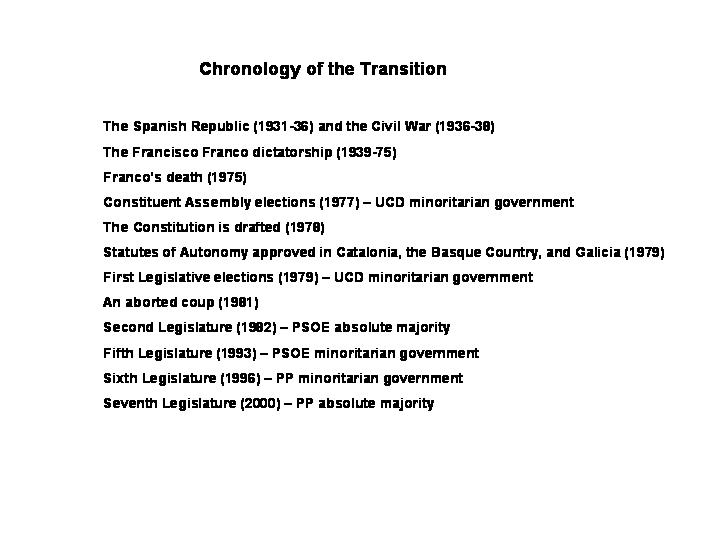
A. Franquist SpainFrance: the Fifth Republic, semi-presidentialism, unequal bicameralism, package votes, motion of censure, powers of the National Assembly vs. the Senate, cohabitation, Council of Ministers, grandes écoles, grands corps, "cabinet," Constitutional Council, "thirty glorious/golden years," May 1968, Alliance for France, Union of the Left, Mitterand's U-turn, the National Front, dirigisme (étatisme), "national champions." Spain: Instituto Nacional de Industria (INI), the 1959 macroeconomic reform, UCD vs PSOE vs AP/PP, the Pacts of Moncloa, the National Reconversion Plan, economic pacts, the Autonomous Communities.1) From Autarky to Statist Industrialization2) The 1959 Macroeconomic Reform and late-Franquist Economic Policy
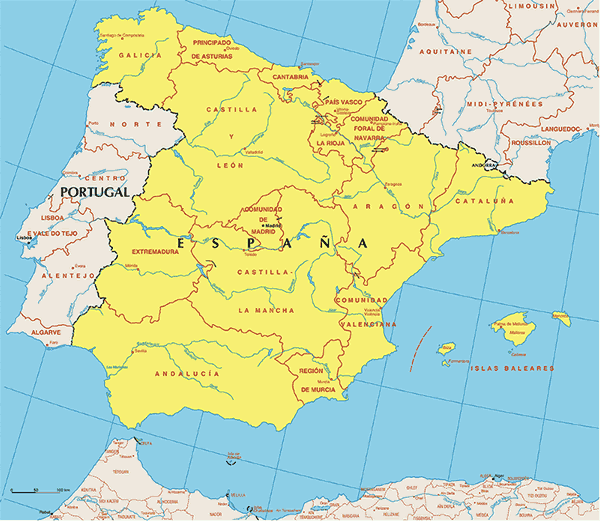
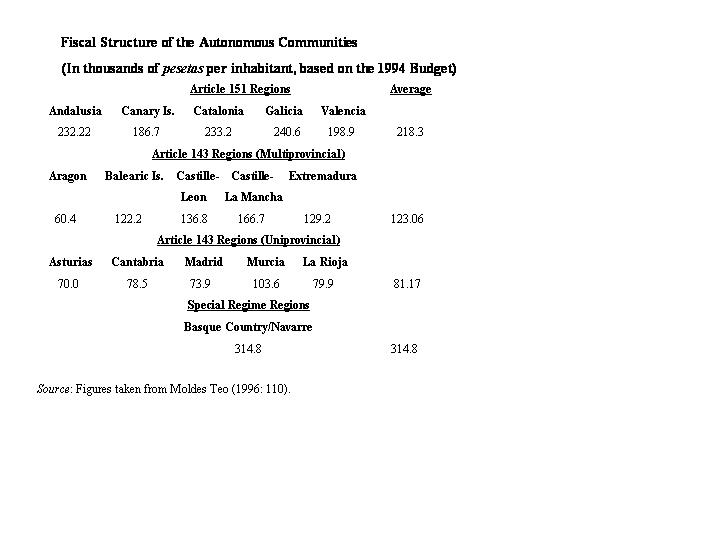
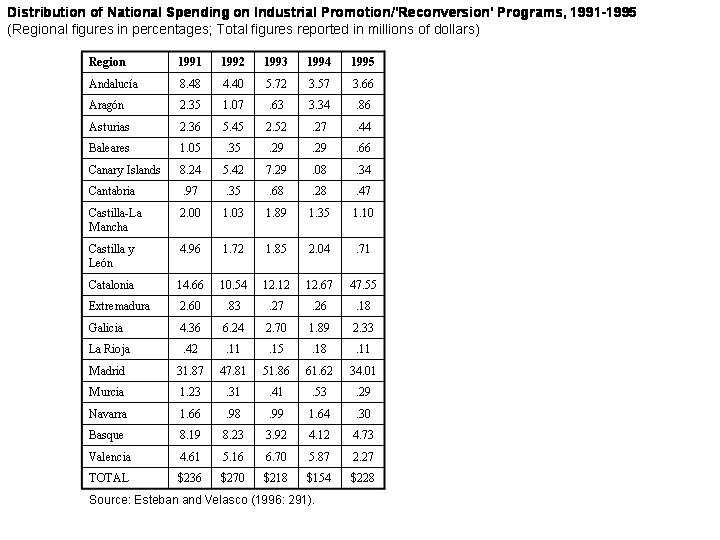
B. The Socialist Period of Industrial Reconversion (map) (graphic) (graphic)
France: Charles de Gaulle, Georges Pompidou, Valéry Giscard d'Estaing, Jacques Chirac, Alain Juppé, Françoise Mitterand, Leonel Jospin, Jacques Delors. Spain: Francisco Franco, Antonio Suanzes, Miguel Boyer, Felipe González, Adolfo Suárez, José María Aznar.
Study Questions:
(April 28, Wednesday)
How did the role of the French state in directing the economy change during the post-war period? Try to delineate distinctive periods and discuss the factors that explain change from one period to another.
What were the major political and economic influences on the Socialist government led by Felipe González? How did these influences shape the content of reforms proposed during the 1980s? Be sure to list three major influences and at least three major aspects to the reforms themselves. How did priorities change during the various terms the Socialists remained in power?
What were the primary political costs the Socialists in both countries paid for engaging in the economic reform agenda they embraced? Might the Socialists have avoided these costs?
Discussion Questions:
What were the limits of dirigisme in France and Spain? Under what conditions were dirigiste models abandoned for liberal reforms?
Compare the political alliance strategies of the Socialists in France and Spain. How did they differ and how did they pursue similar approaches? Based on this assessment, can you say that there is a "Socialist approach" to industrial restructuring? Is it more effective than the one pursued by Thatcher in the U.K.?
Floating Comprehensive Exam Questions: Answer One (Due Monday, May 10)
(A) Compare the French, British and Spanish experiences with reforming industrial relations in the 1980s and 1990s. Construct a hypothesis by focusing on at least two variables you believe explain the process and outcomes of these three cases of industrial relations reform.
(B) The turn toward liberal economic reforms in such distinct political economies such as Britain, Sweden, France, and Spain is seen by some scholars as evidence of the "convergence theory" of "globalization." Compare the four cases and assess to what extent there is evidence in support of this perspective and evidence that qualifies this conclusion (hint: think of Garrett's "rebuttals to the globalization argument").
Note: If you choose not to answer one of these questions, you will have two more sets of exam questions to satisfy the two question requirement. Difficulty level increases with each set.