Political Science 221, Latin American Politics Winter Term 2005
Session 3: Development and Crisis in the 20th Century
I. How did patterns of development shape Latin American politics in the 20th century?
A. Export-oriented Growth: Two Perspectives)1) The Liberal Perspective (graphic
2) The Underdevelopment Perspective (graphic)
B. Structuralism
1) Periodization and Logic of Import-Substitution Industrialization (ISI) (quote) (mechanisms)
C. Dependency Theory
1) Determinist Approaches (graphic)2) Neo-Marxist Variants
3) Cardoso & Faletto (graphic)
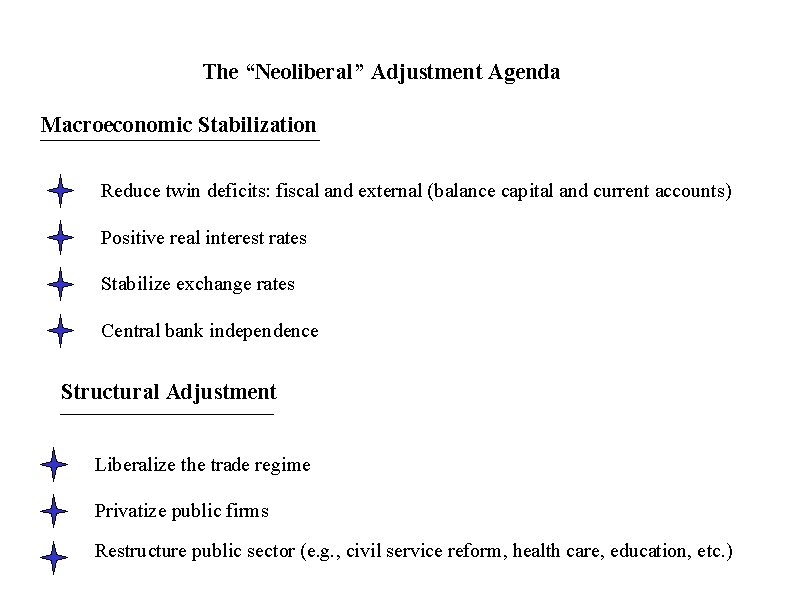
D. Neoliberalism (Back to the Future!) (graphic)
II. How was Latin American society incorporated into development models?
A. Class Formation during the Early 20th CenturyB. The Populist Class Compromise
C. Corporatism
III. Is the neoliberal development model an improvement on the past? Can development models be changed from below?
Debate #1: Neoliberalism
Handouts:
Paper #1 Handout
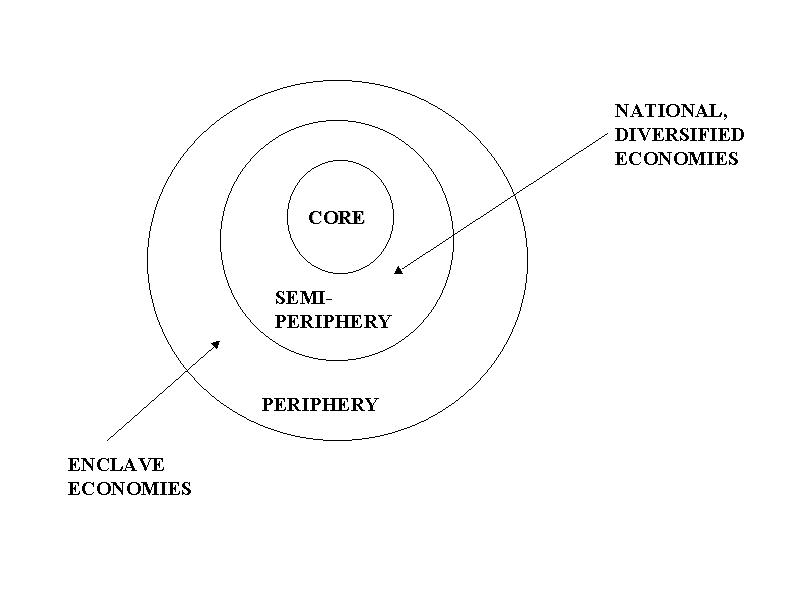
Key Concepts: patterns of development; export-oriented growth (export-oriented industrialization); trade as "an engine of growth"; enclave economies v. diversified national economies ("colonial" versus "national"); primary products/primary exporting; terms of trade; the problem of elasticity pessimism; import-substitution industrialization (ISI); easy v. hard phases of ISI; consumer non-durable goods; consumer durable goods; capital goods; "deepening" ISI; "linkage effects" (forward v. backward); structuralism (developmentalism); U. N. Economic Commission for Latin America (ECLA/CEPAL); "state-led development"; the "import-intensivity of ISI"; balance of payments deficits; LIBOR rates; the debt crisis; the "Lost Decade"; transfer payments; core v. periphery; macroeconomic stabilization; structural adjustment; the "Washington Consensus"; oligarchical democracy; agro-export elite ("comprador class"); middle sectors; the populist class compromise; state corporatism; societal corporatism; bureaucratic rings.
Key Individuals: Raúl Prebisch; Albert O. Hirschman; Andre Gunder Frank; Immanuel Wallerstein; Fernando Henrique Cardoso & Enzo Faletto; John Williamson; Rudiger Dornbusch.
Study Questions:
(January 17, Monday):
What is the importance of economic development for the emergence and function of democracy in Latin America? Identify three main factors and be prepared to discuss how they have affected democracy.
What are the salient differences between “colonial” and “national” patterns of economic development?
What are the major historical characteristics of Brazil’s “state-centered” model of institutional and economic development? Identify the deficiencies that have hindered sustained economic growth, social distribution, and democratization.
(January 19, Wednesday):
Identify two major rationales for and two major deficiencies of the import-substitution industrialization experience in Latin America. How does ISI contrast with export-oriented industrialization (EOI)?
What were the major causes of the Latin American debt crisis? How did the crisis prompt a transition to a “new paradigm” of development?
Identify the major characteristics of the neoliberal paradigm. How do these characteristics contrast with those of the ISI paradigm?
(January 21, Friday):