Political Science 263, European Political Economy Spring Term 2004
Session 3: Convergence Toward Liberalism? The United Kingdom and Sweden
I. The Post-War Political Economy of the United Kingdom
A. The Policymaking Process (graphic)B. The Political Party System
1) The Labour Party3) The "Two" Two-Party System
C. Periodization of the British Post-War Economy
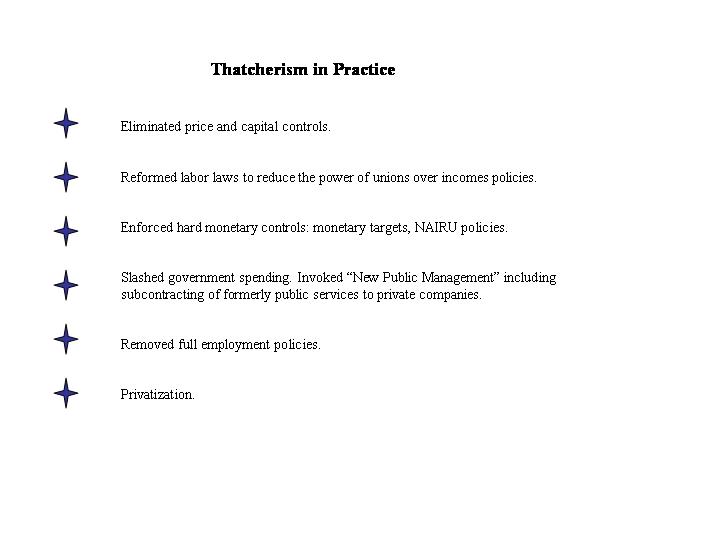
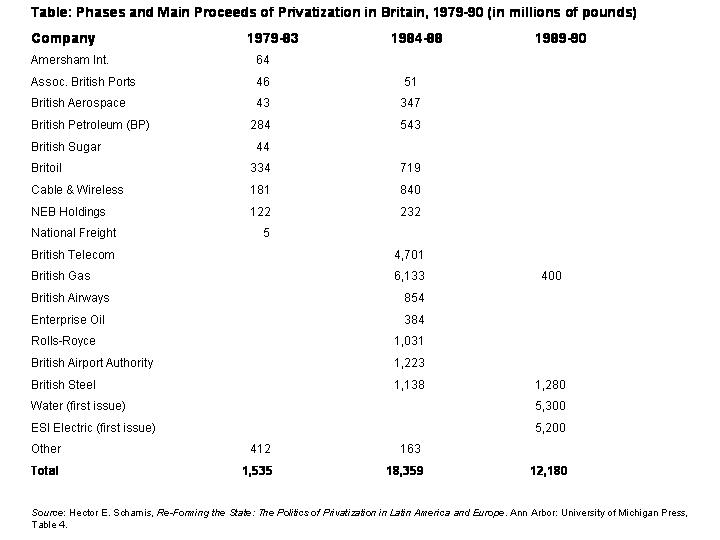
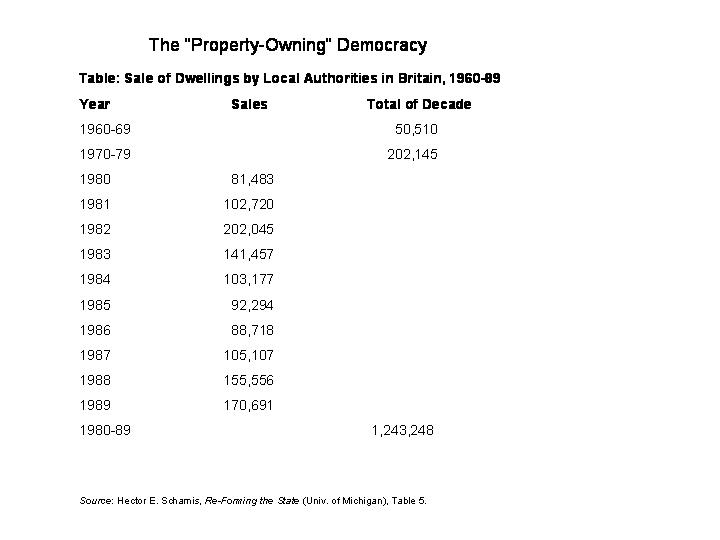
1) The Collectivist Consensus (1945-1979) (graphic)2) The Thatcherite Revolution (1979-1990) (graphic) (graphic) (graphic)
3) New Labour (1997-?) (graphic)
II. The Post-War Political Economy of Sweden
A. The Rehn-Meidner Model (graphic) (graphic)B. The Third Road (graphic)
C. Carl Bildt (1991) and the Return of the SAP (Göran Persson 1996/2002) (graphic)
Handouts:
Debate #1: British versus Swedish Reform
Key Concepts: United Kingdom: fusion of powers, Whitehall, collective responsibility, the cabinet system, new public management (NPM), policy communities, Clause IV, quasi-nongovernmental organizations (quangos), institutional rigidities, 2 class/2 party system, Liberal Democrats, "New Labour," Eurosceptics, the City, 'two- two-party system', the collectivist consensus, social contracts, "winter of discontent," "Iron Butterfly" or "Iron Lady," Thatcherism, 'clever government' and the "Third Way." Sweden: Rehn-Meidner Model, LO, SAP, SAF, Center for Business and Policy Studies (SNS) and Timbro, solidaristic wage policy, active labor market policy, universalistic welfare states, wage earner funds, "Suedo-Sclerosis," wage drift.
Key Individuals: United Kingdom: Benjamin Disraeli, Edward Heath, Margaret Thatcher, John Major, Harold Wilson, James McCallaghan, Neil Kinnock, Tony Blair, Paddy Ashdown. Sweden: Gösta Rehn, Rudolf Meidner, Assar Lindbeck, Kjell-Olof Feldt, Carl Bildt, Göran Persson.
Study Questions:
(April 21 and 23, Wednesday and Friday):
How did economic policy in post-war Britain differ from economic policy in post-war Sweden? List four major features in order of importance and explain why these are the most distinctive features.
What were the limits of British Keynesianism in the post-war period and how did these problems contribute to the crises of the 1970s? Be sure to list at least two persisting problems/constraints.
What were the most essential pillars of the Rehn-Meidner model? List at least three. Then discuss how each of these was challenged by economic and political change during the 1970s and 1980s. Did these challenges constitute a severe undermining of the social democratic class compromise?
Compare the SAP's "Third Road" to the responses of the other small states during the 1980s and 1990s (e.g., Austria, Denmark, Belgium, and the Netherlands). Are there similar patterns of response and success/failure across the cases? If so, what are the most prominent?
Floating Comprehensive Exam Questions: Answer One (Due May 5, Wednesday)
(A) Several scholars you have read (Blyth and Schmidt) regard ideational/discursive factors as determinate in the shaping of policy responses to the crises of Keynesianism. Other scholars focus on political-strategic (Garrett, Pierson) and economic-structural (Iversen & Cusack, Friedman) factors. Which set of explanations best explains why and how the countries under study reformed the prior Keynesian "class compromise." You must compare Britain to at least one other country as the basis for your answer.
(B) Compare the politics of macroeconomic management and welfare state retrenchment in Britain and Sweden during the 1980s and 90s. Which effort at retrenchment was the more successful? Be sure to develop a criteria for assessing "success" based on the constraints of globalization. Consult the special issue in West European Politics as indicated on the syllabus for more on Britain.
Note: If you choose not to answer one of these questions, you will have three more sets of exam questions to satisfy the two question requirement. Difficulty level increases with each set.