Political Science 233, The Global Resurgence of Democracy Fall Term 2004
Session 1: Understanding the Collapse of Democratic Regimes & the Rise of Authoritarianism
I. Definitions
A. The State, Civil and Political Society (graphic)B. Regimes
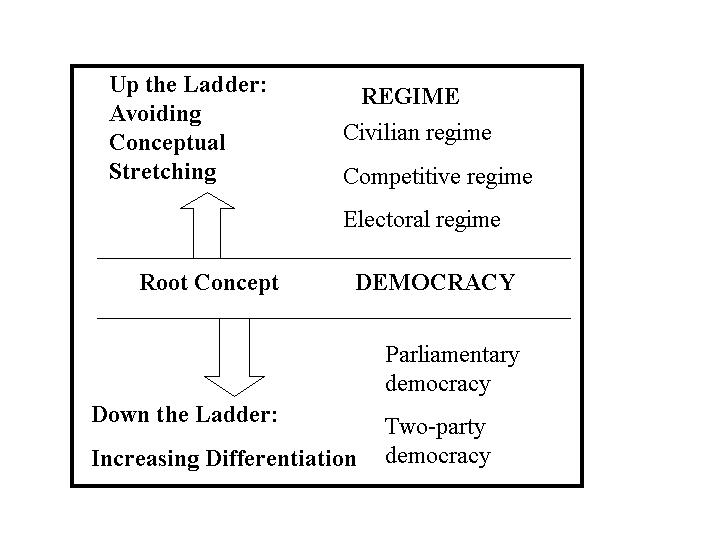
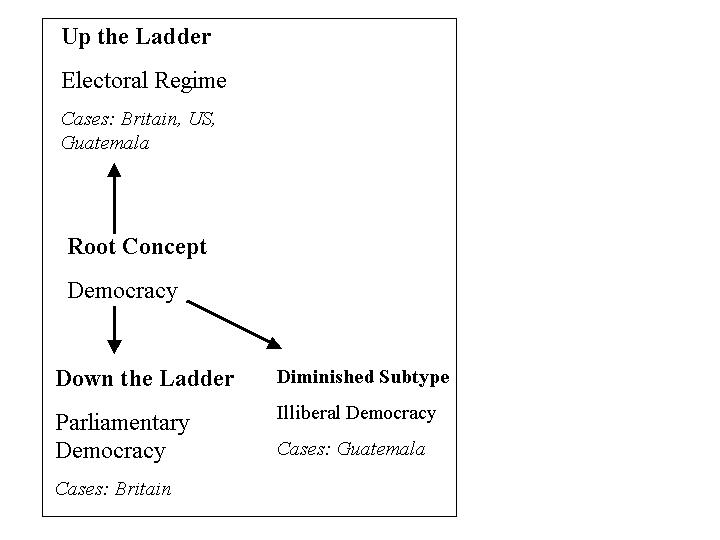
C. Typologies (or "types") (graphic) (graphic)
D. What is democracy? (graphic)
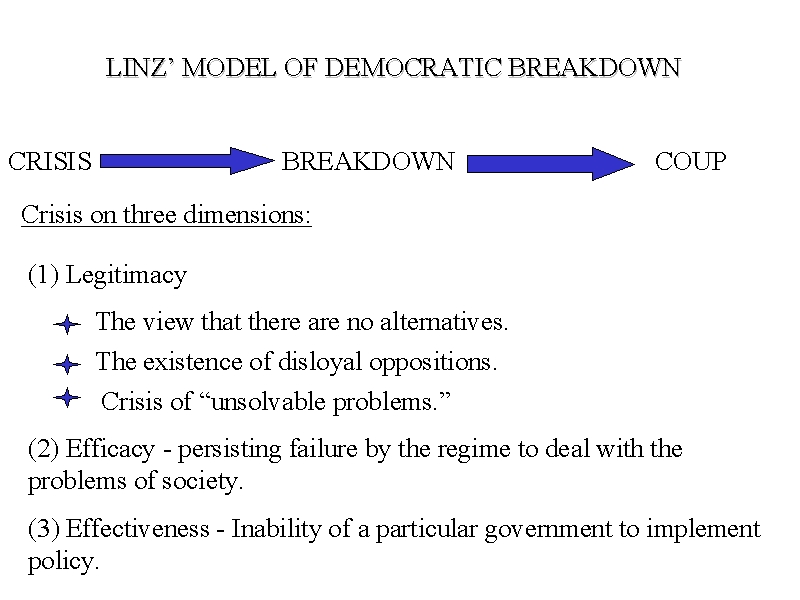
II. A Model of Democratic Collapse (graphic)
A. Loss of Legitimacy1) Definition2) Crisis of "Unsolvable Problems" (graphic)
B. Efficacy
C. Effectiveness
D. Breakdown (Goulart case)
E. The Power Vacuum (quote) (Spanish case)
III. Types of Authoritarian Regimes (graphic)
A. Totalitarianism1) The Party (graphic)2) The Maximum Leader (graphic)
B. Post-totalitarianism
1) Characteristics (graphic) (graphic)2) Usefulness of the Concept (graphic)
C. Sultanism (graphic)
D. Authoritarianism (graphic)
1) Sultanistic Military Authoritarianism2) Military Authoritarianism
3) Non-totalitarian One-Party States
IV. What is "legitimacy" for authoritarian regimes?
Film: "The Architecture of Doom" (Dir. Peter Cohen, Germany)
Handouts and Links:
Paper 1 Handout
Key Concepts: the state; Max Weber's definition of the state; civil society; political society; regimes; state; typologies; Weber's ideal types; "conceptual understretching" v. "conceptual overstretching"; democracy; pluralism; liberal/representative democracy; "self-binding procedures of governance"; legitimacy; Zeitgeist; disloyal opposition; semi-loyal opposition; irredentism; the multinational problem ("stateness"); "demands-performance gap" ("crisis of rising expectations"); efficacy; effectiveness; polarized pluralism; "the heresthetics of coup making"; totalitarianism; monism; post-totalitarianism (early, frozen, and mature); sultanism; patrimonialism/patron-client relations; authoritarianism; eugenics; negative utopias; the Fuhrer principle (Führerprinzip) (the Maximum Leader); polycratic tendency; psychology of conspiracy; post-totalitarianism by choice or by decay; "totalitarianism without terror"; evolutionary type; patron-client ties; rentier states; el jefe máximo; "military as institution" v. the "military as government"; bureaucratic authoritarianism; strong and weak one-party systems; exclusionary and revolutionary (inclusionary) one-party systems.
Study Questions:
(September 16, Thursday)
What is Linz' definition of "legitimacy?" Is it a useful concept for understanding the vulnerability of democratic regimes to breakdown? Why is the use of force the ultima ratio for legitimacy?
What are the main elements of the party system that might make democracies more prone to breakdown? Be sure to list the three most important, in your estimation.
Based on your reading of Linz' theory, which factors do you believe are most important in determining whether a democracy will breakdown: (1) "structural" problems (the inefficacy of policy-making, economic crises, etc.) or (2) the activities of disloyal or semi-loyal oppositions?
(September 21, Tuesday)
Which type of authoritarian regime is best developed conceptually? Which type is the least developed (that is, might be too unclear to be useful)?
How do sultanistic regimes differ from totalitarian or military dictatorships? Be sure to list the three most salient differences.
(September 23, Thursday)
Is the application of the concept of "legitimacy" to non-democratic regimes appropriate? What are the two most important dimensions of non-democracies that it highlights? If you believe that this application is inappropriate, specify three major reasons.